

About
Law, Data, and Methods is an intensive summer program designed to cultivate students' understanding of quantitative and empirical research methods in law. Throughout two weeks of immersive learning, instructors will demonstrate how to formulate legal research questions, collect and structure data (such as judicial decisions), clean and process datasets, perform quantitative and computational analysis, and interpret the results in meaningful legal terms.
Taught by distinguished faculty members from National Taiwan University and guest experts in law and technology, the program combines lectures, hands-on workshops, and instructor-guided projects that allow students to apply quantitative and computational methods to real legal data. Students will gain practical experience working with authentic datasets and learn how empirical insights can enrich legal scholarship, policymaking, and practice.
Beyond the classroom, participants will visit key legal institutions and enjoy cultural activities in Taipei, gaining firsthand insights into Taiwan’s dynamic legal system and vibrant society. Upon completion, students will receive 2 NTU short-term program credits and an official Certificate of Completion.
Research Highlights NTU College of Law
Bridging Law, Data, and AI
Law, Data, and Methods integrates empirical legal research with computational thinking. Through hands-on exercises in data analytics, AI-assisted legal reasoning, and visualization, students will learn how to extract and interpret patterns in legal information—preparing them to navigate the emerging landscape of data-driven law and digital governance.

Immersive Learning in Taiwan’s Legal and Cultural Environment
Participants will not only study Taiwan’s legal frameworks but also experience them in context. Visits to the Judicial Yuan, major law firms, and regulatory agencies will be paired with cultural excursions around Taipei, fostering a holistic understanding of how law interacts with society and culture.

Course
2026 Summer+ Programs
Law, Data, and Methods (August 10 - 21, 2026)
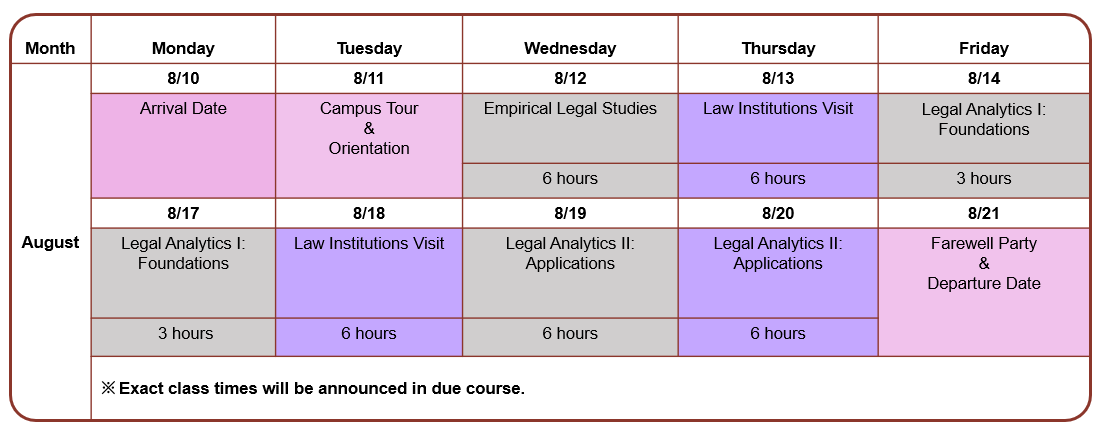
Law, Data, and Methods (2 NTU short-term program credits)
This two-week intensive program introduces students to the use of quantitative and computational methods in legal research. The curriculum is divided into three components—Empirical Legal Studies, Legal Analytics I: Foundations, and Legal Analytics II: Applications—designed to guide students step by step from understanding empirical legal reasoning to applying data-driven analytical tools in practice.
Participants will learn how to formulate legal research questions, collect and structure data (such as judicial decisions or statutory texts), clean and process datasets, and perform statistical and computational analysis to uncover patterns in legal phenomena. By the end of the program, students will be equipped with practical skills to conduct empirical studies and critically reflect on how quantitative evidence can inform legal scholarship and policymaking.
*The participants will receive an academic transcript with 2 NTU short-term program credits upon completion. If they wish to have their credits approved, they should consult their home institutions and credit advisors in advance.
*Admission Letter, Official Transcript, and Certificate of Completion will be provided electronically. If a physical copy is needed, please notify us in advance.
*Grading Policy
Student performance will be evaluated based on two components:
- Class Participation and Attendance – 50%
Active participation in class discussions, group activities, and consistent attendance are required.
- Hands-on Project and Practical Exercises – 50%
Assessment will be based on the quality of students’ work during the applied sessions, including data analysis exercises and the final hands-on project conducted in the Legal Analytics II: Applications module.
Empirical Legal Studies
This course introduces the logic and design of empirical research in law. Students will examine how legal hypotheses can be tested using real-world data, from judicial opinions to legislative and regulatory records. Through case-based discussions, the course explores research design, variable construction, sampling, and interpretation of quantitative results, emphasizing the importance of empirical rigor and transparency in modern legal scholarship.
Prof. Chung-Chia (Patrick) Huang is currently an Assistant Professor at the College of Law at National Taiwan University. He received his J.S.D. from the University of Chicago. Dr. Huang specializes in criminal law, white-collar and financial crimes, and money laundering laws.
Legal Analytics I: Foundations
This course provides an introduction to the core concepts and workflows of quantitative legal analysis. Students will learn how to formulate data-driven research questions, collect and clean textual legal data, and build structured datasets for analysis. The instructor will demonstrate basic programming and statistical tools for processing judicial decisions and legal texts. The course emphasizes conceptual understanding, data ethics, and the interpretive challenges that arise when applying computational methods to legal materials.
Prof. Sieh-Chuen Huang is Vice Dean for International Affairs and Professor of Law at NTU. She holds a doctoral degree from Hokkaido University and specializes in trust law, family and inheritance law, and AI & law. Her recent research focuses on explainable AI, computational legal analysis, and comparative studies on trust and supported decision-making.
Legal Analytics II: Applications
Building on the foundational methods introduced earlier, this course offers hands-on experience in applying computational and statistical techniques to legal data. Students will work with real-world datasets to perform data visualization, regression analysis, and simple natural language processing. The course culminates in guided projects where participants analyze selected court judgments or legal texts and discuss their findings in light of legal reasoning and policy implications.
Prof. Hsuan-Lei Shao is an Associate Professor at Taipei Medical University. He holds a Ph.D. in political science from National Cheng-Chi University and specializes in computational social science. His interdisciplinary research integrates quantitative reasoning, algorithmic modeling, and explainable AI, with applications across legal analysis, healthcare, mass communication, international relations, and legislative studies.
Fees
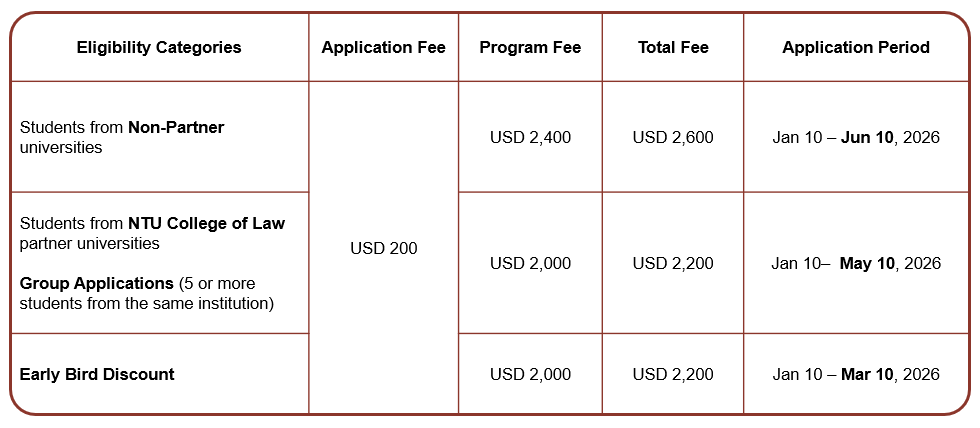
The program fee includes tuition, accommodation, orientation, cultural courses, program activities, meals on class days, travel insurance, and welcome and farewell events.
*Housing information will be confirmed later.
Refund Policy
The application fee is non-refundable under any circumstances.
The program fee is:
- fully refundable if NTU cancels the program.
- 90% refundable if the student cancels the program before the start of class.
- 50% refundable if the student cancels the program before finishing 1/3 of the program.
- not refundable if the student cancels after finishing more than 1/3 of the program.
*Please note our program is a package, including some optional activities. The fee for activities won't be refunded if you choose to be absent from these activities.
*For PRC students only: A Taiwan Entry Permit application fee (USD 40) will be added to the program fee. This fee is non-refundable.
How To Apply
Student Status
This program is open to:
• Non-Taiwan-based students aged 18 or above, currently enrolled in a university or college outside Taiwan, with a minimum GPA of 2.7.
• Taiwan-based undergraduate or graduate students currently enrolled in a university or college in Taiwan, with a minimum GPA of 2.7.
(Up to 5 seats are available for Taiwan-based applicants)
Age Requirement
Applicants must be 18 years old on or before August 10, 2026, the official entry date of the program.
Academic Background
This program welcomes undergraduate and graduate students from law, social sciences, public policy, or related disciplines.
No prior legal background is required.
Foundation Skills
Applicants should have completed at least one introductory course in statistics or programming.
Students who have not taken a formal course may still apply, but are encouraged to provide evidence of self-directed learning, such as completion of online courses (e.g., Coursera, edX, Udemy) or other equivalent training related to data analysis or computational methods.
English Language Requirements
All courses in this program are conducted in English.
Students whose first language is not English should have at least an intermediate level of English proficiency (e.g., TOEIC 600 or above).
Application Review
Your application will be reviewed after all required documents have been uploaded.
You will receive your admission result via email within approximately five (5) business days.
Important Notice
The NTU College of Law may take photographs and record videos during classes and program activities for documentation and promotional purposes.
By applying for this program, you consent to the use of such photos or videos—including those featuring participants—for public display or promotional materials without further notice.
Application Date
January 10 – June 10, 2026
How to Apply
1. Register and verify your email.
Please use an active email account that can reliably receive international messages. Email services based in mainland China (e.g., QQ Mail) may not receive system notifications and should be avoided.
2. Fill in the online application form.
Please enter your personal information exactly as shown on your passport to avoid processing delays.
3. Pay the application fee of USD 200 online by credit card.
Please note that the application fee is non-refundable under any circumstances.
4. Upload all required documents after your payment has been processed:
• A headshot photo in JPG format (required)
• A color copy of your official transcript in PDF format (required)
• Student Enrollment Verification (required only for applicants holding a PRC passport)
5. Check the result.
Once all required documents are submitted, NTU will review your application.
You will receive an acceptance or rejection notice within approximately 5 business days via the verified email address.
6. Pay the program fee within 5 working days after receiving the acceptance notice.
All payments must be made online by credit card.
Bank wire transfers and other payment methods are not available.
Your admission will not be confirmed until your payment has been successfully completed.
7. Provide admission information.
After NTU confirms your payment, you will be prompted to provide the necessary information required for enrollment and pre-arrival preparation.
8. Receive admission documents.
NTU will issue the Admission Letter and Pre-departure Guide prior to the program's commencement.
Important Notice for Applicants Requiring Visa or Entry Permit Assistance
If you require NTU's assistance with your visa or entry permit, please complete your application and pay the program fee by May 20, 2026. Although the general application deadline is June 10, 2026, visa/entry permit processing may take several weeks. Late submissions may risk not receiving the required documents in time for the program, which starts on August 10, 2026.
中國大陸同學申請規定
入臺證及赴臺簽證辦理須時1-2個月,請務必於 5 月 20 日前 完成申請及繳費,並繳清所有入臺證辦理所需文件。在您的入臺證尚未正式批准前,請勿離開您的所在地(或所在第三國),感謝您的配合。請注意,切勿自行辦理「自由行簽證」,否則將無法以自由行簽證參與本課程!

Contact Us
Ms. Wan-Ping(Elisa)ZHONG
ntutop@ntu.edu.tw
Tel: +886-(0)2-33663366#55380